Precision Mold Assemblies & Optical Sub-Systems
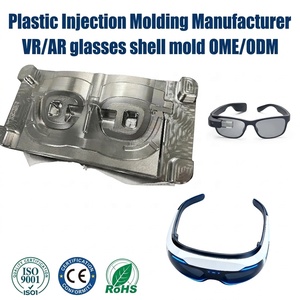
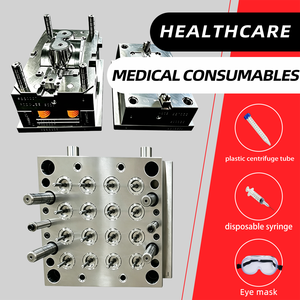
Explore our production-ready toolings spanning high-transmittance VR/AR polymer elements, impact-resistant medical barrier PPE, and ultralight TR90/PA12 ergonomic eyewear architecture.
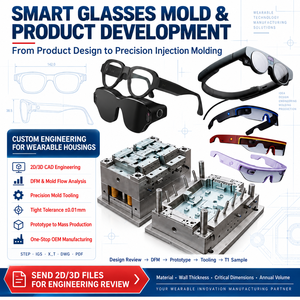
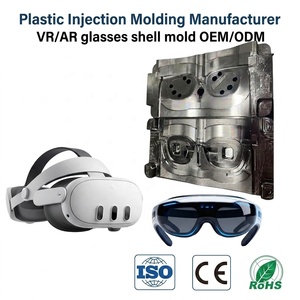
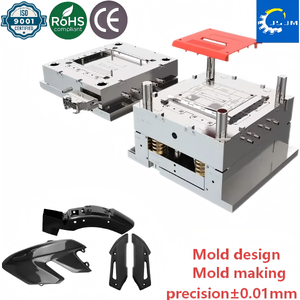
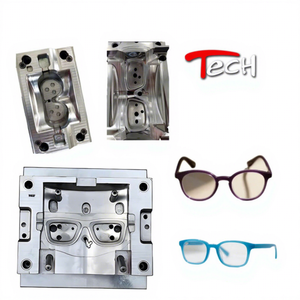
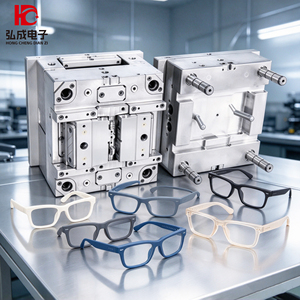
Industrial Scale Meets Precision Engineering
Combining over seven decades of tooling heritage with high-throughput injection capacity. We eliminate subcontracting vulnerabilities by executing tooling design, thermodynamic mold-flow simulation, micro-machining, multi-shot molding, and optical metrology under a single audited roof.
Full Vertical Integration
From DFM analysis and Moldflow rheology simulation to multi-axis high-speed CNC EDM milling and Class 7 cleanroom packaging, every phase stays under strict in-house protocol to prevent hand-off errors.
Strict IP Discretion
OEM/ODM programs operate under strict bilateral NDAs. Proprietary 3D CAD geometries, patented acoustic waveguide channels, and unique hinge dynamics are safeguarded in isolated, access-controlled network servers.
Certified CE & ISO Compliance
Full adherence to Regulation (EU) 2016/425 for Category II PPE safety glasses and EN ISO 12870 ophthalmic optics. All tool steels and medical polymers match REACH, RoHS, and biocompatibility regulations.
Engineering Precision in Eyewear Injection Molding: Dimensional Stability, Optics, and Polymer Dynamics
In the contemporary eyewear supply chain, the transition from traditional subtractive acetate routing to multi-cavity thermoplastic injection molding represents a vital technological leap. For procurement directors, original equipment manufacturers (OEMs), and optical brand curators, sourcing CE certified eyewear injection molding manufacturers and exporters requires analyzing structural rheology, tool kinematics, gate design, and internal stress mitigation rather than merely comparing unit prices.
1. The Mechanical Reality of Advanced Eyewear Resins
Optical and wearable frames demand contradictory material characteristics: structural rigidity to sustain lens retention, flexible memory to withstand cyclic temple deflection, skin-safe biocompatibility, and chemical resistance to sebum and cosmetics. Standard injection polymers fail to resolve these competing criteria under high-speed thermal cycles.
| Polymer Substrate | Flexural Modulus (MPa) | Abbe Value (Refractive Dispersion) | Thermal Distortion Temp (°C) | Key Eyewear Applications |
|---|---|---|---|---|
| Grilamid TR90 (PA12) | 1,200 – 1,400 | N/A (Opaque / Tinted) | 115 – 130 | Ultralight sports frames, high-flex hinges, resilient optical temples |
| Optical Grade PC | 2,300 – 2,500 | 30 – 32 | 130 – 140 | Ballistic goggles, CE EN166 face shields, VR front display lenses |
| PMMA (Acrylic Optical) | 3,000 – 3,300 | 58 | 95 – 105 | High-transmittance AR waveguide covers, non-corrective zero-power demo lenses |
| Bio-Polyamides (Bio-PA) | 1,100 – 1,350 | N/A | 100 – 120 | Eco-certified sustainable designer collections, ESG-compliant optical lines |
2. Precision Tooling Metrics: Preventing Moldflow Residual Stress
A primary failure mode in injection-molded eyewear—notably in clear polycarbonate safety frames and VR display mounts—is uncontrolled birefringence caused by residual flow shear. When high-pressure melts freeze unevenly within the mold cavity, anisotropic stress fields develop. Under polarized illumination, this displays as chromatic fringe distortion, causing user eye fatigue and reducing structural resistance to impact.
To prevent this, our mold engineering teams deploy conformal cooling configurations manufactured via direct metal laser sintering (DMLS) alongside balanced runner layouts. Maintaining mold surface temperature equilibrium within ±1.5°C across the entire perimeter of the eye-wire aperture prevents anisotropic shrinkage. As a result, lens-groove circumferences achieve repeatability within ±0.015mm, allowing optical prescription lenses to snap in securely without thermal warping.
3. Future Procurement Trends: Smart Wearables, Co-Injection & Green Resin Mandates
Global procurement teams face two rapid industry transformations over the coming decade:
- Integration of 3C Wearable Enclosures (Smart Glasses): As demonstrated by augmented reality frames and audio-integrated spectacles, front frames and temples now serve as structural housings for micro-circuit boards, bone-conduction transducers, lithium-ion pouch cells, and waveguide prisms. Tool designs must combine structural over-molding with thin-wall cavities (down to 0.7mm) while maintaining IP67 water and dust ingress ratings.
- Stringent European Packaging and Polymer Traceability: Global regulatory frameworks, driven by the EU Circular Economy Action Plan, increasingly require documentation of supply chain origin and carbon footprints. Sourcing strategies are moving rapidly toward bio-circular castor-derived polyamides and closed-loop runner regrind systems that maintain mechanical yield without resin degradation.
Frequently Asked Questions
Direct technical answers addressing tool steel selection, export compliance, prototyping cycles, and minimum batch economics.